

FMUSER Announces Hardware-Based IPTV System for ISPs in the Middle East and Africa
FMUSER launches a smart ISP TV system for local providers to deploy stable digital television networks despite slow internet infrastructure in emerging markets.
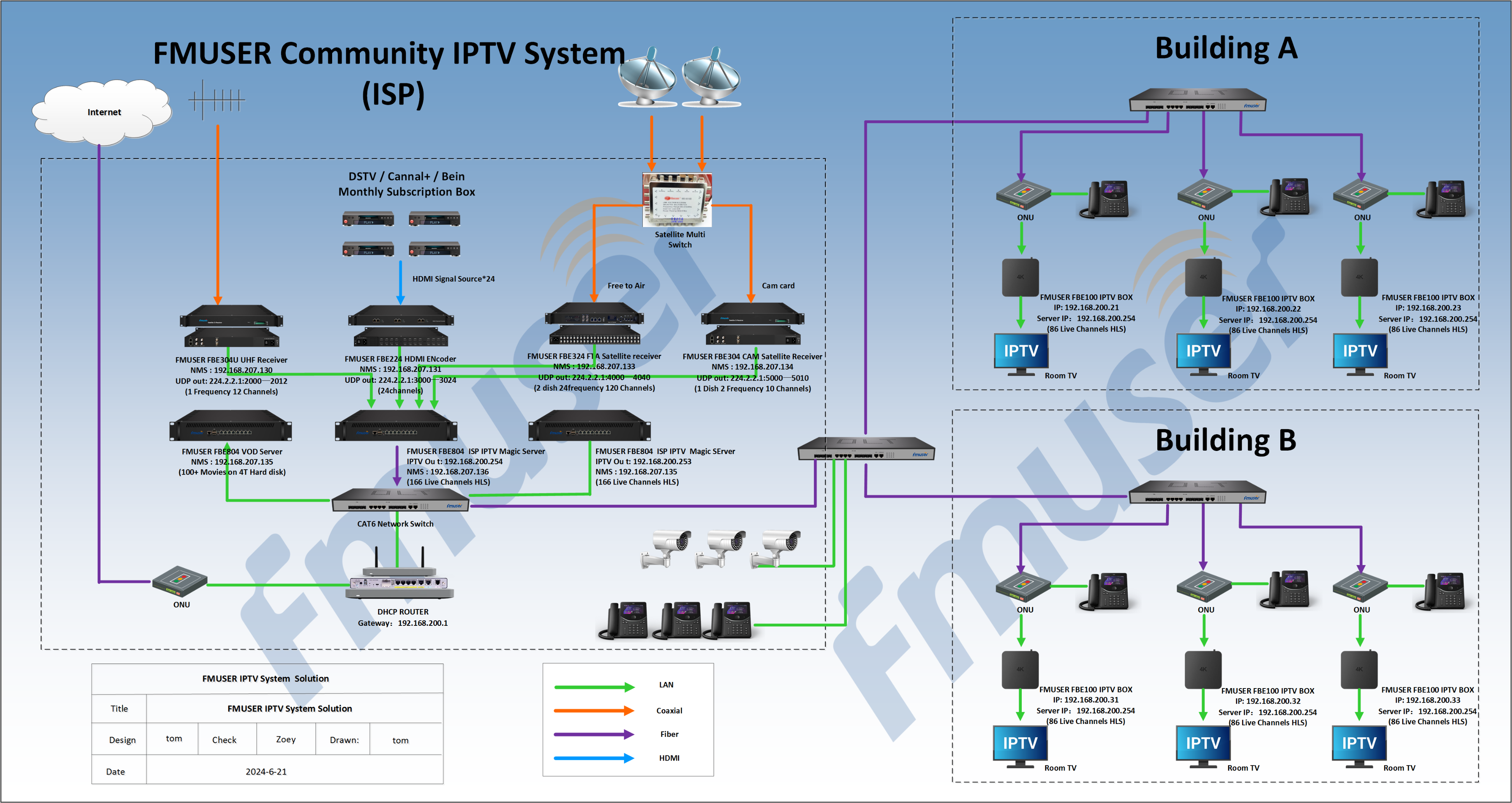
This topology diagram illustrates the hardware signal flow of the FMUSER Community IPTV System for ISPs. It details the physical connections from the local headend gateways and servers down to the end-user ONUs and IPTV boxes across multiple buildings.
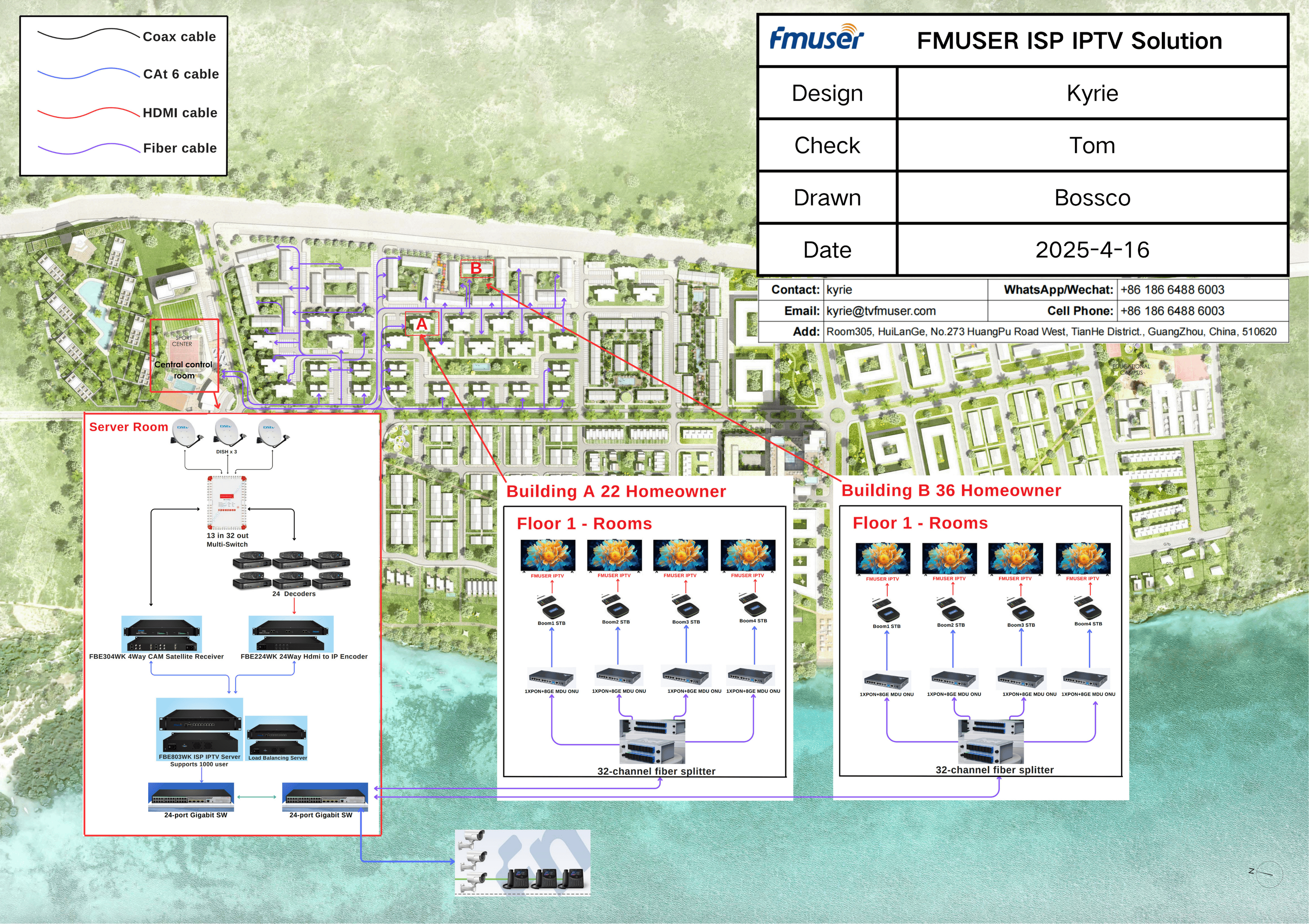
Technical diagram of the FMUSER ISP IPTV solution,showing signal flow from the headend to residential blocks via fiber-optic splitters. It illustrates a localized network delivering stable digital TV to 58 homeowners while bypassing external bandwidth bottlenecks.

The FMUSER FBE013 smart hotel IPTV set-top box is supplied with the FBE 015 PLUS custom remote control and essential cabling, ready for immediate guest room installation.
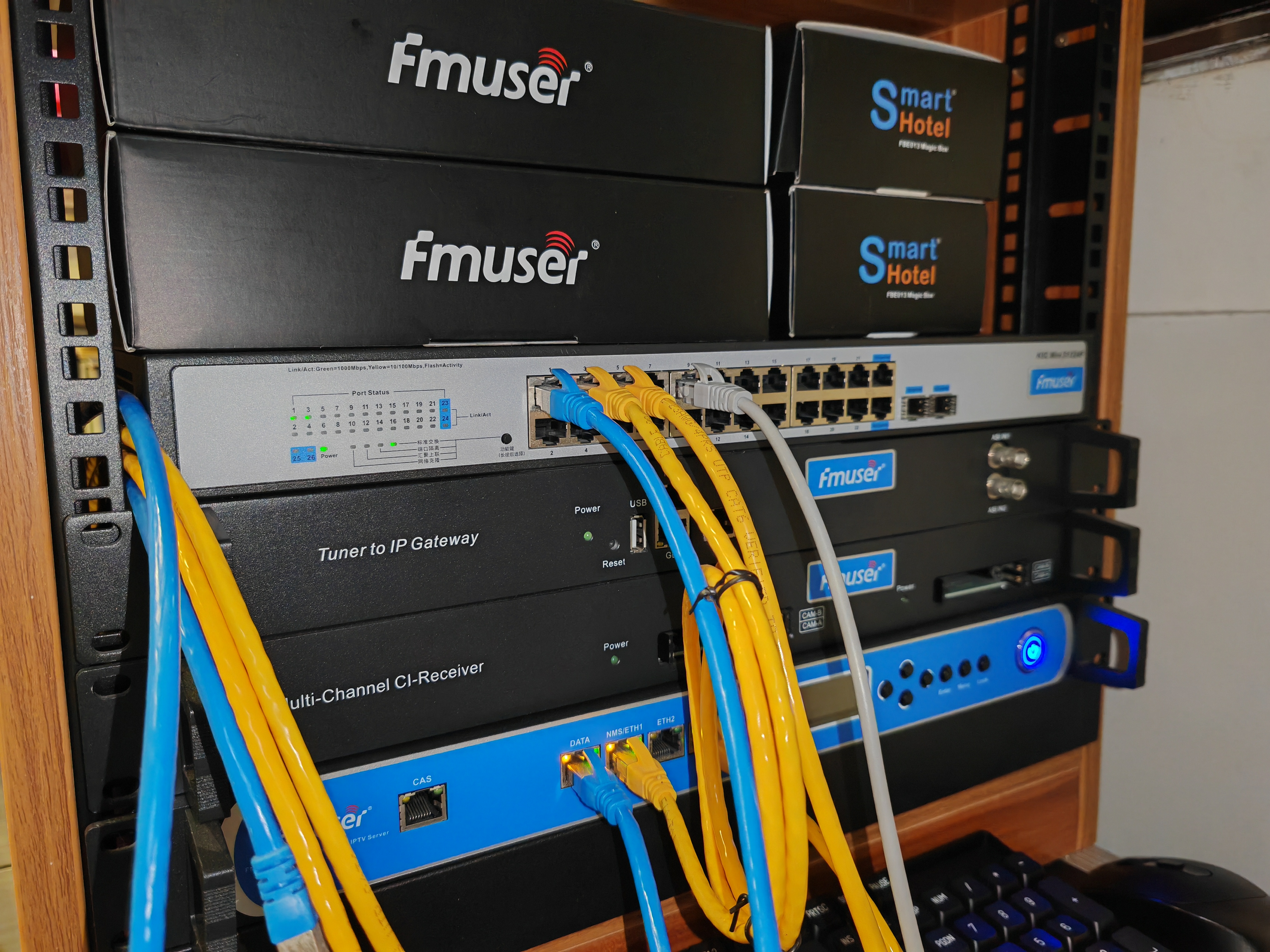
The FMUSER Hotel IPTV headend equipment neatly installed in the server room, utilizing existing CAT6 networks for reliable and cost-effective video distribution.
FMUSER launches a hardware-based IPTV system for ISPs to deploy stable digital television networks despite slow internet infrastructure in emerging markets.
GUANGZHOU, CHINA, April 13, 2026 /EINPresswire.com/ -- FMUSER has announced the deployment of a localized, hardware-focused ISP IPTV solution designed to operate in regions with limited internet infrastructure. Engineered for system integrators and local network operators in the Middle East and Africa, these IPTV solutions for ISPs provide the physical components necessary to establish digital television networks over local area networks (LAN) rather than relying on high-speed external broadband.The architecture of this smart ISP TV system shifts the burden of video packet delivery away from external networks and relies entirely on localized processing power. By utilizing professional hardware encoders and the FMUSER FBE803I IPTV server, the equipment physically converts radio frequency (RF) signals from satellite dishes or UHF antennas into multicast network traffic.
"When operating in environments with poor internet connectivity, video delivery must bypass the external network bottleneck," stated a Lead Network Engineer at FMUSER. "By processing high-bitrate video streams directly at the local headend, the Guangzhou company provides ISPs with a physical infrastructure that maintains video stability before the signal even enters the distribution network."
To address the specific operational and financial requirements of rural areas and budget-conscious markets, the system incorporates several distinct engineering protocols:
High-Availability Broadcast Infrastructure: To mitigate single-point failure risks during high viewership traffic, the server architecture utilizes dual-machine hot standby and load balancing. Furthermore, if a live channel signal experiences interruptions, the system activates an automatic fallback protocol that seamlessly switches to a localized media library to prevent screen blackouts and minimize subscriber complaints.
Streamlined Equipment Deployment: The standard hardware roster includes the FMUSER FBE013 set-top box (STB) and standard gigabit network switches. These Android STBs are pre-configured prior to shipment and support centralized bulk management. This allows field technicians to connect the devices directly to the local network without complex on-site coding, while enabling ISPs to manage hundreds of residential nodes from a unified interface.
Latency Prevention: To counteract high network latency, custom user interfaces are hardcoded and cached directly on the STBs. This ensures the IPTV solutions for ISPs maintain responsive navigation and support localized Video on Demand (VoD) via the FMUSER FBE803I servers without pulling data from the external internet. Additionally, remote cloud maintenance systems allow for 24-hour diagnostic support without requiring immediate on-site dispatch.
Infrastructure Integration: The smart ISP TV system connects directly with existing user billing and management servers. For older residential complexes, the IP network can be bridged over existing coaxial cables, allowing ISPs to upgrade signal distribution without running new fiber.
One-Time Procurement Model: The system operates strictly on a direct hardware purchase model. By removing recurring software licensing fees, local ISPs and network operators can calculate fixed deployment budgets and design independent billing structures based on local economic conditions.
By deploying this localized equipment, technology teams in the Middle East and Africa can build stable video networks and maintain functional digital television services despite significant external bandwidth limitations.
"After deploying the FMUSER IPTV system to introduce digital TV packages to our 500 subscribers, our ISP business experienced a 30% growth," stated Mr. Hajir, a local network operator based in Somalia.
About FMUSER:
FMUSER is a broadcast and network equipment supplier based in Guangzhou, China. The company specializes in manufacturing physical hardware for audio and video transmission, providing engineering components and localized network solutions for system integrators, broadcasters, and ISPs globally.
Tom Lee
FMUSER
+86 139 2270 2227
sales@fmuser.com
Visit us on social media:
LinkedIn
Facebook
YouTube
How Internet Service Provider (ISP) build Non-Internet IPTV Subscription Business.
Legal Disclaimer:
EIN Presswire provides this news content "as is" without warranty of any kind. We do not accept any responsibility or liability for the accuracy, content, images, videos, licenses, completeness, legality, or reliability of the information contained in this article. If you have any complaints or copyright issues related to this article, kindly contact the author above.
